Wait, what?
Had to dig deep on this one. Read it several times, several. Then decided to try out Claude. Maybe ‘he’ could help me understand. Not sure I do yet, but I’m working on it. The person I know who posted this I’m pretty sure supports the current administration. So I am confused. My only thought was, they think that this is what Democrats are doing.
This:
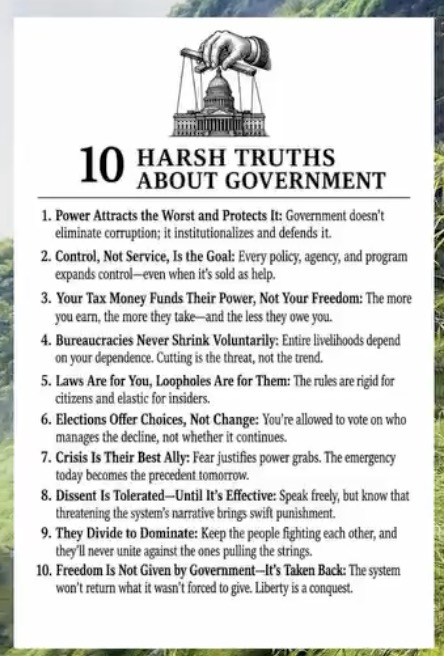
Like most things I see today from one side of the aisle, I was confused by the poster since this read like something they would be against. And then the comments section from the original poster of the image? WoW! The original poster, posted with a question, “Which truth do you think more people need to understand?” After reading some of the comments it seemed to me they don’t understand any of it. I’m not sure I do yet entirely. Except that they all seem to be true and embraced by the current administration.
Other than occasionally using the Writing Tools in Notes for grammar, I’m not an AI user. A couple of weeks ago I threw something into Claude for the first time. Someone commented on another post saying that they were “clueless about tariffs”. I asked them to clue me in. They didn’t. Of course. I thought, what would Claude think. What might that tell me as opposed to what I’d read and heard over the last year and a half. So I copied the ten (10) statements into Claude and asked for a summary.
The nine points, condensed: (by Claude)
- Control over service – Programs framed as “helping” citizens are really mechanisms for expanding institutional reach.
- Taxation as power transfer – Taxes fund the state’s authority rather than returning value to the people who pay them.
- Bureaucratic self-preservation – Agencies and programs resist shrinking because jobs and influence depend on their continued existence.
- Unequal application of law – Ordinary citizens face strict rules; those with insider access find ways around them.
- Limited electoral choice – Voting selects managers of the existing system rather than offering a real alternative to it.
- Crisis as opportunity – Emergencies are used to justify expanded powers that then become permanent.
- Conditional free speech – Criticism is allowed until it becomes influential enough to threaten those in charge.
- Divide-and-rule tactics – Keeping the public divided prevents unified opposition to concentrated power.
- Freedom through resistance – Liberties aren’t granted by government—they’re reclaimed through pressure and struggle.
Overall framing: This is a libertarian/anti-statist argument portraying government as inherently self-serving and expansionary, with each numbered point functioning as a standalone maxim reinforcing distrust of centralized authority.
Worth noting — this is a strongly one-sided ideological framework (closer to a manifesto than a balanced analysis). If you want, I can also lay out the counterarguments people make against this view (e.g., that public goods, regulation, and courts often do constrain power, or that “control vs. service” is a false binary), so you have both sides to weigh.
One of the comments to the post was, “This is socialism defined.”. Wait, what? Hey Claude, can you define this in one word?
Claude: Weighed philosophical terminology capturing power concentration critique
Anti-statism — the core idea is that the state, by nature, seeks to preserve and grow its own power rather than genuinely serve the people it governs.
Other single-word options depending on emphasis:
- Statism (if used as the target of critique, i.e., “a critique of statism”)
- Kakistocracy (rule by the worst, corrupt actors)
- Tyranny (if emphasizing the oppressive angle)
“Anti-statism” is probably the most accurate fit, since the whole piece is essentially a distrust-of-centralized-power manifesto.
Okay, so not Socialism. Didn’t think so.
We have some work to do … that will never get done.
I remain confused.